
17. Seventeenth Lecture: Unconscious, Obscurity, and Phenomenal Consciousness
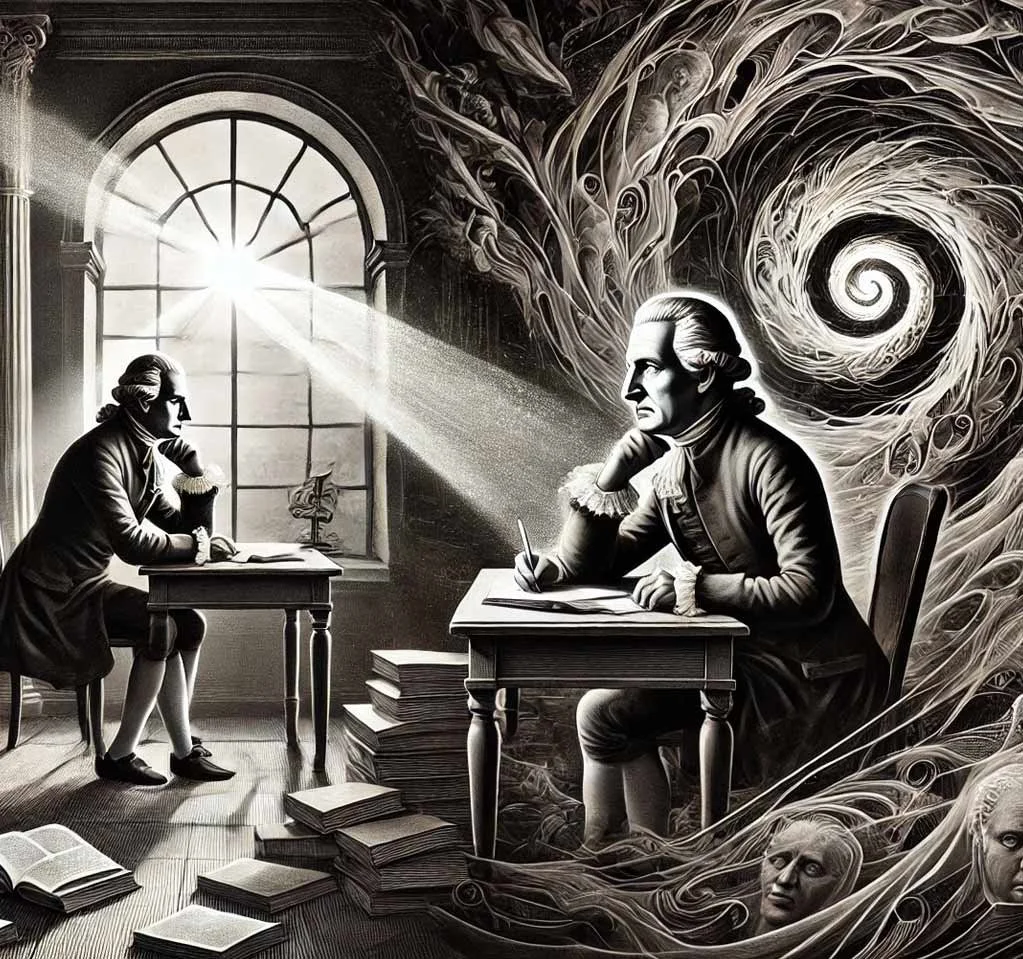
This lecture marks the beginning of integrating ideas from Kant with those of more contemporary authors in the fields of psychology and philosophy. I believe that Kant did, in fact, recognize the inevitable importance of the unconscious; however, placing significant emphasis on it would have made it more challenging for him to conceptualize his other mechanisms regarding perception, understanding, and moral philosophy. Drawing significantly on Kant's earlier works, I explain the concepts of obscurity and phenomenal consciousness and propose how they relate to the unconscious in more modern terms.
We can recognize that Kant's Transcendental Idealism continues to play a significant role in contemporary philosophy, particularly in epistemology and metaphysics. In addition, Kant's ethics, particularly his formulation of the categorical imperative, is often considered one of the four main ethical theories, alongside intuitionism, consequentialism, and Aristotelian virtue ethics. However, let us now explore his approach from a more psychological perspective and in connection with Evolutionary truth.
To understand the influence of true primordial subjectivity on an individual, we first need to conceptualize the unconscious in Kant's approach. Kant never used the term "unconscious" in his theory. However, he did acknowledge the existence of a realm of thought and experience that cannot be fully understood or accounted for by our conscious mind and its inherited laws of understanding. He referred to this as the "obscure" and believed that it is the source of our creative and imaginative abilities, including artistic genius. According to Kant, the obscure is not directly accessible to conscious awareness, but its influence can be felt in how we perceive and experience the world.
He argues that "a contradiction appears to lie in the claim to have representations and still not be conscious of them; for how could we know that we have them if we are not conscious of them?" He writes, "how my understanding may form for itself concepts of things completely a priori, [...] with which principles experience must be in exact agreement and which nevertheless are independent of experience – this question, of how the faculty of understanding achieves this conformity with the things themselves, is still left in a state of obscurity."
While Kant's theory of a priori knowledge (e.g., "categories of understanding" and "laws of understanding") provides a framework for understanding how we can have certain types of knowledge independently of experience, it does not fully explain how we can know mathematical truths, such as "two plus two equals four," without counting objects in the world. Nor does it entirely account for how we have a priori knowledge of the basic principles of geometry, such as the Pythagorean theorem, or how we conceptualize "a perfect circle."
Concerning categories and the unconscious, we can make an interesting distinction. Kant used the concept of "indefinite judgment," referring to judgments that are not determined by the categories of understanding. These judgments fall between the categories, being neither determinate nor entirely clear, but rather vague or ambiguous. For example, the statement "he feels all right" could be considered an indefinite judgment because it is not strictly determined by the categories of "good" or "bad." Thus, Kant highlighted how our categories of understanding can sometimes be vague or ambiguous. Slavoj Žižek expanded on this idea, characteristically relating it to the Lacanian concept of the unconscious (the "Real") in his works.
Next, let us explore obscurity, which is closely tied to the unconscious in Kant's philosophy. Obscurity can be related to situations where "the reflections that understanding has done in obscurity" influence our perceptions. For example, "we will be appraised in society first from our appearance, gestures, and clothing, although upright men shall retroactively judge us from our intelligence or character." The degree of obscurity in such situations is difficult to precisely determine; however, it undoubtedly exists.
Some of the mechanisms Kant recognizes can also be linked to cognitive unconsciousness. For example, if a soldier translates a decoded enemy message, he may later reflect on the degree to which he was rationally aware of all the calculations he performed. There can be a certain level of obscurity involved.
According to Kant, the principle of purposiveness allows us to judge that objects in the world have properties necessary for fulfilling a specific purpose, even when we lack direct perceptual evidence of these properties. For instance, if one sees a house from far away without being able to discern its details, one might still judge that it has windows, doors, and walls on each side. This process, too, involves a degree of unconsciousness.
In his Lectures on Anthropology, Kant discussed how devices, such as telescopes and microscopes, alter our perception. For example, examining the Milky Way through a telescope reveals stars, correcting the ancient Greek interpretation of it as a "river of milk." For the Greeks, it was an obscure representation of stars because such a judgment was made without the benefit of telescopic observation. Kant recognized that the limitations of our senses sometimes lead to flawed or obscure judgments and that tools can help correct these errors. One might argue that the "filling in" of perceptual flaws with incorrect judgments could be linked to unconscious processes.
Another interesting example relates to art and creativity, areas often governed by more obscure processes than other facets of life. For instance, a musician immersed in playing the guitar might achieve a level of performance unattainable through conscious effort alone. In such a state, the musician is blind to conscious thought, achieving a flow that "perhaps otherwise, with all diligence and care, could never hope to bring off so well."
In addition to "obscure," we can also connect unconsciousness to perceptions based on phenomenal consciousness. For Kant, "clear" and "indistinct" refer to the degree of specificity and determinacy with which a representation is held in mind. For example, when observing a sunset's vivid colors, one might initially experience all the hues without consciously reflecting on them. Kant would describe this as a "clear" and "indistinct" experience, where all representations are held in consciousness but not immediately reflected upon. These representations, however, can be accessed through his concept of "I think"—the capacity to bring all aspects of an experience to conscious focus. Today, some of these experiences that Kant classified as "clear" and "indistinct" might also be considered unconscious to some extent.
Kant's idea of a "degree of reality" is tied to his distinction between appearances (phenomena) and things in themselves (noumena). The "degree of reality" we attribute to an object depends on our mode of perception and understanding. One could argue that this degree of clarity operates on a scale—from zero, at which point we cannot conceptualize the object, to full conceptualization. Conversely, it can decrease to zero, representing negation. This shifting perception could be compared to the unconscious to some degree.
Kant also explicitly acknowledges the vastness of the human unconscious. In Anthropology from a Pragmatic Point of View, he states: "The field of our obscure ideas is immeasurable; [...] our mind is like an immense map with only a few points illuminated". The idea of the unconscious mind as immeasurable remains widely accepted among scientists today. It is generally believed that the unconscious is vast, containing far more information and processes than the conscious mind, making it extraordinarily difficult to measure or quantify.
In the simplest terms, Kant admits there is a realm of thought and experience that cannot be fully comprehended by the conscious mind or its inherited laws of understanding. He refers to this realm as the "obscure." He also posits that our representations of the world possess varying degrees of clarity.
