
16. Sixteenth Lectue: Kant and the Biological Truth -From Blind Synthesis to Modern Neuroscience
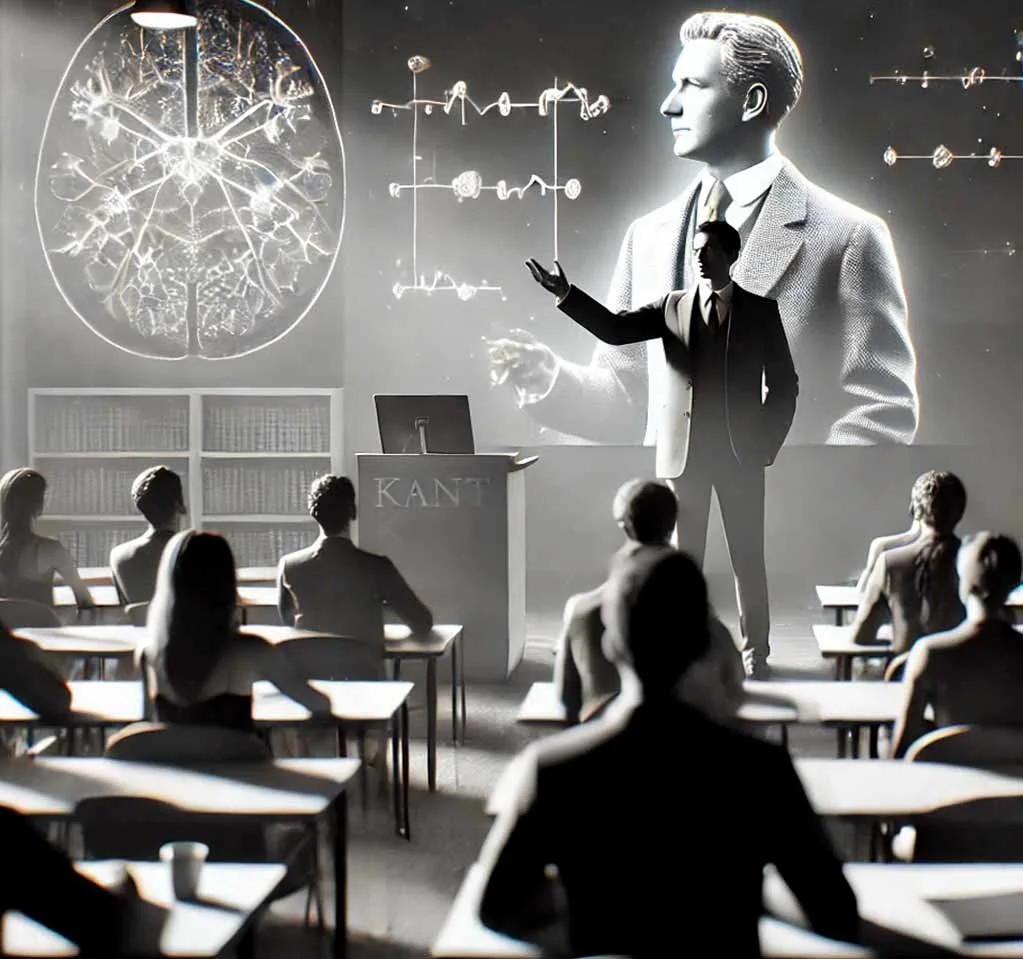
In this lecture, I present my defense of Kant in light of the biological truths and neuroscientific conclusions that scientists have explored in far greater detail centuries later. While some interpret the changes between the first and second editions of the Critique of Pure Reason as contradictions, they can more accurately be seen as refinements. In the first edition, Kant placed more emphasis on the conscious use of the mind to maintain continuity in cognition. By the second edition, he acknowledged that much of this processing occurs unconsciously—a shift that aligns with modern understandings of the brain's limitations in managing complex processes consciously. This lecture invites us to critically examine Kant’s evolving framework and ultimately—true to the genius of Kant’s thought—conclude that his revisions in the second edition provide a more accurate account of how we comprehend the world.
Another notion of unconscious influence can be found in Kant's description of sensibility as “the receptivity of our mind to receive representations insofar as it is affected in some way.” When Kant describes the concept of "transcendental logic," he asserts that understanding also requires the "spontaneity of cognition."
We can interpret this to mean that when an individual's mind is affected by "sensations," it is not actively engaged and therefore operates unconsciously. However, regarding the "spontaneity of cognition," Kant refers to "the faculty for bringing forth representations itself," which can be considered a conscious activity. Let us explore this idea further.
First, we can state that unconscious thinking is crucial for survival when perceiving sensory data. For example, as we walk through a room, in just one second, an avalanche of sensory inputs triggers emotional and cognitive processes to produce motor outputs. The brain processes information from the eyes, ears, muscles, joints, and other sources in the body. It delivers a coherent perception of our surroundings, focusing our attention based on goals and expectations. Emotions emerge — we may feel threatened, excited, or calm — while the brain plans navigation routes to avoid obstacles and reach desired locations. Simultaneously, memories and biases influence our behavior.
From a scientific perspective, it is estimated that the brain processes approximately 11 million bits of information per second regarding incoming sensory data. Of this, only a fraction—typically less than 40 bits per second—is processed consciously, while the rest is managed unconsciously or discarded. This is part of the biological wisdom we are born with and rely on. The brain, with its limited resources, must prioritize essential information to ensure survival. Discarding most sensory data and analyzing the remainder primarily through unconscious mechanisms is crucial because it allows the brain to focus on the most relevant information and respond quickly to potential threats.
Now, let us return to Kant and consider how he approached this question.
In the first edition of the Critique of Pure Reason, Kant introduces the concept of "spontaneity," which "synthesizes" (combines) the manifold (of experience) through an action of "synthesis"—a process carried out by the subject as “an act of its self-activity.” Kant asserts that "spontaneity" serves as the “ground of a threefold synthesis”: Apprehension (the mind grasps sensory input as intuition), Reproduction (we imagine it), and Recognition (we conceptualize it).
Kant describes the "synthesis of apprehension" as being combined with the "synthesis of reproduction," which he terms the "transcendental faculty of the imagination." Without this combined synthesis, we would not be able to represent sensory input as a unified whole—a process that aligns with unconscious activity.
However, Kant also states that consciousness is necessary to maintain continuity: "that which we think is the very same as what we thought a moment before." Without this continuity, he argues, “all reproduction in the series of representations would be in vain.” This suggests a role for "conscious memory," since the "synthesis of reproduction" itself is an unconscious activity. If one had to consciously process such syntheses, it might severely affect mental well-being.
The human brain processes vast amounts of sensory information, much of which is filtered and handled unconsciously. Certain mental health conditions—such as ADHD, Autism, OCD, PTSD, Schizophrenia, and Depression—are often associated with difficulties in processing sensory information. Sensory overload, characterized by anxiety, stress, fear, or panic, is a common symptom linked to problems in filtering sensory data.
In the second edition of the Critique of Pure Reason, Kant refines his ideas, stating that synthesis—whether pure or applied—is an “action of putting different representations together and comprehending their manifoldness in one cognition.” This clarification allows for synthesis to be an unconscious process rather than always requiring full conscious awareness.
Kant elaborates that "transcendental logic" relies on synthesis as a necessary prerequisite: “to bring under concepts not the representations but the pure synthesis of representations.” He introduces the term "pure synthesis," which refers to a mental process that can occur without conscious awareness. Additionally, Kant introduces the concept of "blind" synthesis, comprising three components: (1) “the manifold of pure intuition,” (2) “the synthesis of this manifold by means of the imagination,” and (3) “the concepts that give this pure synthesis unity.” This shift downplays the need for "spontaneous synthetic activity" to be "cognitively conscious," suggesting that synthesis can operate entirely unconsciously.
Thus, Kant's second edition introduces the idea of "blind" synthesis, where the mind unconsciously synthesizes representations. This marks a departure from the earlier emphasis on conscious, spontaneous activity in the synthesis process.
It is important to recognize that Kant's ideas on spontaneity, synthesis, and understanding were developed in the late 18th century, long before the emergence of modern neuroscience and its insights into brain function. Despite this, Kant's philosophical contributions remain significant. Many see his ideas as foundational for contemporary theories on self-organization and cognitive processing.
In simplest terms, Kant’s exploration of unconscious thinking goes beyond merely describing a subset of subjective consciousness. Instead, unconscious thinking emerges as a necessary counterpart to self-consciousness, enabling the type of conscious experience we are familiar with and playing a vital role in our survival and daily functioning.
