
18. Eighteenth Lecture: Mild Critique of Kant’s Approach to the Unconscious - Kant and Freud
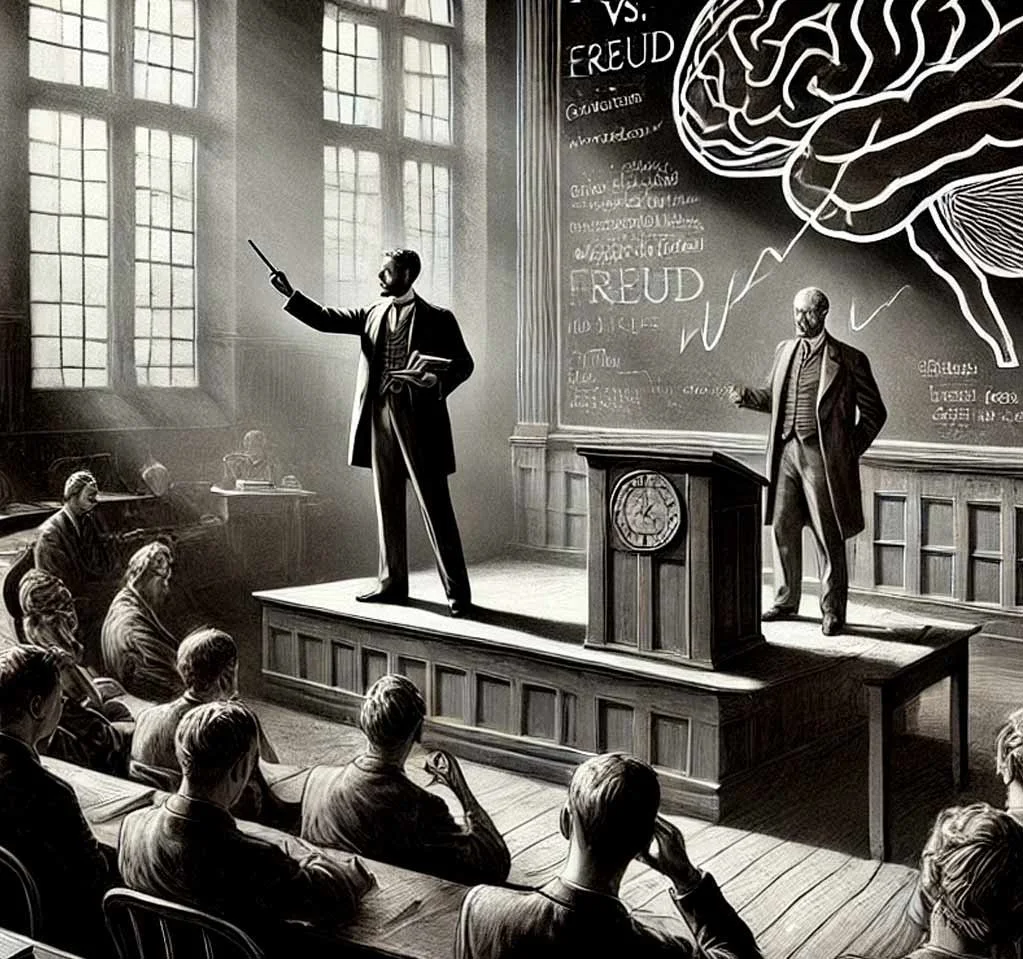
In this lecture, we explore subjectivity, approaching it through Kant’s conceptualization of the unconscious (though he never explicitly described it as such) in comparison to similar mechanisms as articulated by the acclaimed founder of the unconscious, Sigmund Freud. As I have argued for Kant’s significance (a task that, all things considered, has never been particularly challenging), I aim to do the same for Freud, who, in my opinion, has been unjustly downplayed in some contemporary psychology programs. The essence of his work forms the unquestionable foundation of virtually every therapeutic approach. We examine the rigidity of Kant’s concept of "self-consciousness" through the "I think" and compare it with Freud’s perspective on the unconscious.
We can also find exciting connections when we examine the interactions between our true subjectivity (as a subconscious agent of our actual thoughts) and the "self" as an "I" in relation to Kant's approach.
“All that seems necessary for an introduction or a preliminary is that there are two stems of human cognition, which may perhaps arise from a common but to us unknown root, namely sensibility and understanding, through the first of which objects are given to us, but through the second of which they are thought.”
Kant introduced a rigid construct concerning "self-consciousness":
“The ‘I think’ must be able to accompany all my representations; for otherwise, something would be represented in me that could not be thought at all, which is as much as to say that the representation would either be impossible or else at least would be nothing for me.”
This concept is known as the "principle of pure apperception." Although all knowledge begins with experience, according to Kant, there is—and cannot be—an experience of the noumenon.
Considering the actual effects of the unconscious, as we shall explore, one can say that it is always uncertain to what extent human experiences are influenced by primordial subjectivity. Let us look at a concrete example next.
Suppose someone has an implicit, solid racial bias without recalling its origins from childhood. They might believe, for example, that people belonging to a particular group are less open, less conscientious, or more violent. That belief, in turn, may unconsciously influence their behavior, thereby confirming the bias.
Freud describes this as "deferred action" ("Nachträglichkeit" in German), referring to the process by which an event or experience is reinterpreted and given new meaning at a later time. A person may have had experiences in childhood or early life that formed an implicit bias against a particular racial group. These experiences may have been traumatic or emotionally charged but not consciously remembered or recognized as such. The bias, in turn, may influence their perceptions, attitudes, and behaviors toward members of that racial group, even if they are unaware of the underlying cause.
The unconscious mind can connect new experiences with past traumas and memories through "deferred action" and create new meanings for them. This can lead to anxiety, anger, suspicion, or other negative emotions, which in turn shape the individual's behavior in ways that reflect their implicit bias, potentially contributing to the construction of situations that confirm the initial bias.
Thus, one can search for empirical evidence for such beliefs from conscious experiences (through sensation, perception, and experience). When it comes to Kant, such new experiences are accessible with the "I think," making them legitimate for the individual as "phenomena." However, the source of the original belief may be rooted in the unconscious, and the entire thread of concepts could be a consequence of a belief that remains inaccessible as "noumena."
In addition, a person could (being at the primordial level influenced by an unconscious false belief) generate new objective "knowledge" through subjective experiences that contribute to collective understanding, which may further influence others. Kant refers to this process when he states, "the synthetic judgment becomes necessarily universally valid, hence objective, and changes from a perception into experience." Thus, we can consider this as one of the sources related to unconscious influence.
