
The God-shaped hole in the heart – On the impossibility of one-handed parenthood
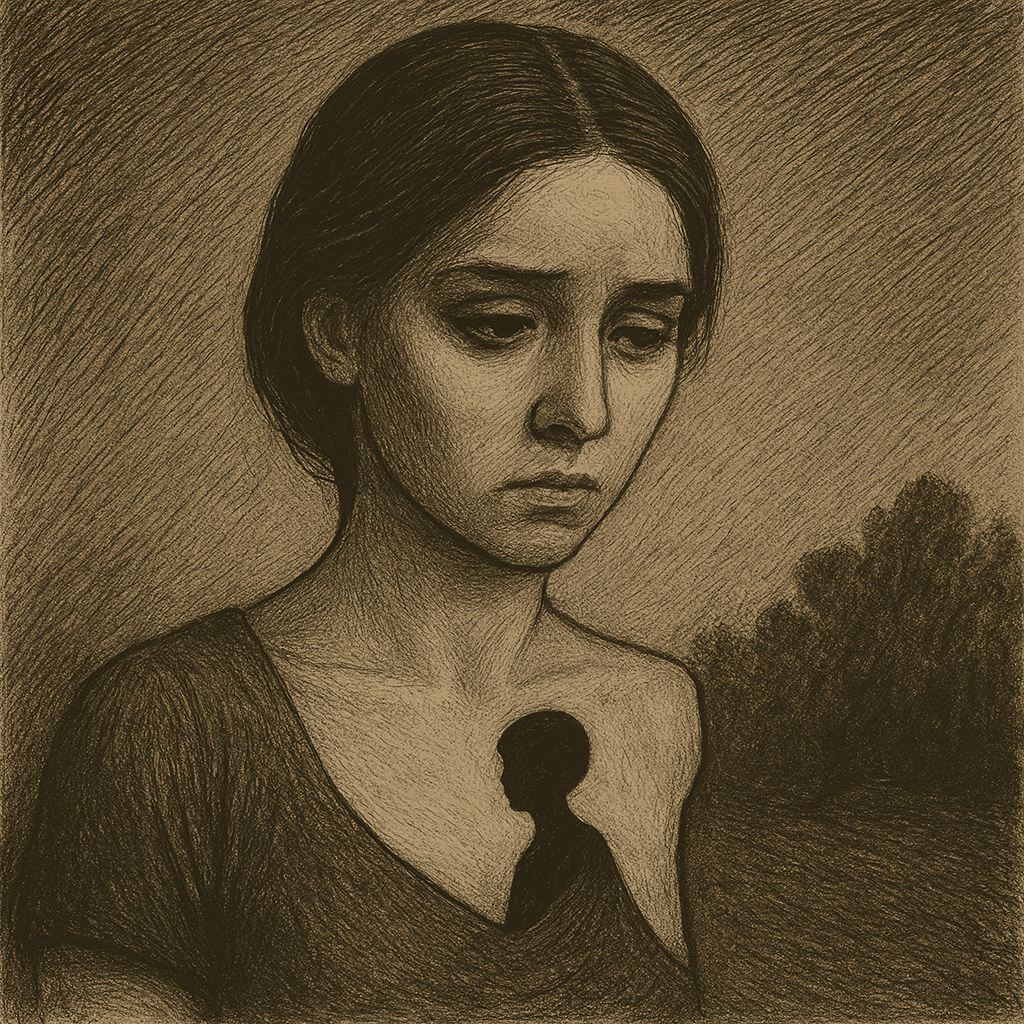
When Cain thinks he is Moses – a story of abandoning one’s children through murdering the ideal within, by signing a Mephistophelean contract
As in most debates, the other side often assumes that I immediately drift into Biblical themes. But this “reading into it” is mistaken. In reality, it is usually the other side who gravitates there - without realizing it and often denying it outright. People rarely understand that they always exist inside a story, framed narratively - either as an example or as a warning. And this story has, in truth, already been written, and its ending is known.
Parents, family, and home as the intermediary layer between culture and the individual
Society can carry moral culture forward only on a general level - by giving the real responsibility of upbringing to the layer closer to the individual: the family. Leaving a child to be raised by society is, in most cases, a cruel experiment - a trial whose success rate is far below one percent. Naturally, a child will eventually collide with society and with the reality of life, which is almost always harsher than anyone can adequately warn about. It is a vortex containing both the inherent tragedy of life and the pure cruelty that multiplies within human environments.
This is not pessimism - it is positive realism. For a child to cope with life, parents usually see two pathways: total protection from the nature of society and life (the very common option), or a gradual, controlled exposure to reality, tragedy, and pain - investing their energy into making the child as strong as possible.
From the standpoint of preserving and developing a child’s survival skills, only the second option truly works. But we also should not glorify those parents who have effectively dropped the bar to the minimum - those who abandon protecting the child entirely, while offering no personal example whatsoever. Both extremes are equally destructive to a child’s survival ability: immediately handing over the task of upbringing to society without meaningful involvement and retreating from the role of mother or father, or constructing around the child an irrational, fantasy-based “bubble of reality.” The stronger the walls of such a bubble grow, the later in life it bursts - and then the shock is absolute. A child “perishes” in their collision with reality even if this occurs in the second, third, or even fifth decade of life.
The abyss cultivated under the myth of the “golden middle path”
When parents separate, most progressive societies reveal a peak form of naïve optimism - an abyss cultivated under the myth of the “golden middle path.” Naturally, this begins long before the divorce itself, and there is little point in blaming any single mediator, lawyer, police officer, psychiatrist, social worker, child-protection officer, children’s representative, or even the court system.
The European Union itself is a construction marked by a dual longing: on one hand a genuine aspiration toward freedom and independence, and on the other a built-in desire to surrender freedom and be taken care of — a system that simultaneously “liberates” and binds. For many countries, the latter dominates: they join not out of thirst for freedom but out of a sweet craving for dependence. In this sense, the United States has always been a global phenomenon to me - impossible yet still possible, and without experiencing that society up close, one cannot understand the meaning of actual freedom on a supra-national level.
The same craving for dependence extends downward through the hierarchy into state institutions tasked with supporting the “sustainability” of broken families. Through liberal-progressive sloganeering, a completely absurd myth has been installed: the myth of the “golden middle path.” Children - often in their most sensitive developmental years - are expected to accept claims such as “neither parent is at fault (and if they are, then both are, due to human imperfection),” “the family remains even after the parents separate,” “both parents have their truth,” “both are right in their own way and both love you very much,” “a child needs both parents,” “no one is bad, both are good,” and so on.
This is precisely how a tragic bubble is built around the child. A fiction is created - the idea that a “golden middle path” exists, a myth that “family” can take any form and that “breaking up a family is not tragic, but simply a normal part of life.” In reality, this is not a golden middle but an abyss into which the child falls while walking with foolish naïveté toward the cliff’s edge, believing in the existence of a bridge that isn’t there.
Life’s logic does not support such two-faced deception of children at the state level, and parents cannot be relieved of the role of creating for their children a durable and clear structure of values - one that contains moral absolutes.
A turn toward an unsolvable equation
And now we move a step closer to religious themes, whether we want to or not - at least on the narrative level. Let us take a concrete example of the idea that “both parents have their truth” and see what level of destructive cognitive dissonance this produces in a child’s psyche.
Let us assume the parents cannot reach an agreement regarding custody, and one parent wishes to spend more time with the child or raise the child more than circumstances at a given moment allow. When no agreement is reached - and emotions are usually running high - the parent turns to the state for help, and the mechanism described earlier begins: efforts to “find common ground” between the parents’ worldviews and to construct the “golden middle path.”
Here, however, an interesting moral question arises. Leaving the family often stems from fatigue, stress, desire for novelty, personal dissatisfaction, lack of happiness, addiction issues, peer influence, or some other form of the parent’s personal “pursuit of happiness.” After leaving for such reasons, the departing parent frequently has nothing substantial to accuse the other parent of. The tragedy is precisely this: the parent who actually raises the child (or children) most of the time appears to manage well - and the “life truths” they instill in the child (such as being honest, not lying, taking responsibility, respecting the ideal of family, etc.) are not inherently false.
In such a situation, the parent - mother or father (though increasingly it is the mother) - faces two fundamental choices:
To admit one’s mistakes, human weakness, naïveté during certain periods of life, the abandonment of the ideal, and personal failure; to apologize, to ask forgiveness, and to turn toward the other parent with complete honesty, seeking and offering humanity;
orTo solidify one’s decision - in the style of Greek tragedies or the tyrants known in every religion - as something inevitable and “right,” even when the price is the child’s psychological stability, doubling down on the stakes.
Total openness and honesty (option 1) is rarely rejected. And yet, this is the path almost none of them choose.
The demonization narrative as a contract of signing off one’s children
When a parent turns to the court, they quickly sense that the prerequisite for achieving the “best outcome” is to demonize the other side to the extreme. And if they find lawyers with no moral boundaries - lawyers who encourage a “scorched earth strategy” - the danger is immense: the parent may take a step that effectively writes themselves out of their children’s lives forever, voluntarily, pushed forward by greedy or intrigue-seeking companions and various “helpers.”
Lawyers construct and cultivate a naïve myth: that children can be “brought over,” “taken back,” “given the right home,” “saved from the other parent,” “put back on the correct path,” etc. When the one turning to court is, for example, the mother, the lawyer pulls out a pre-written narrative in which the father is portrayed as violent in every category (economic, sexual, mental, physical, religious, psychological, social, political, ideological, biological - the list can be expanded to every existing or imaginable discourse).
In these narratives, the father is presented as a “demon” - a toxic narcissist who was violent “the whole time,” not from any specific moment onward. A message taken out of context - “you mayregret this” - becomes a death threat and evidence of mania or antisocial personality disorder; a photo of a father bathing with his children becomes a pedophilia allegation and “proof” of likely sexual abuse; consensual intimacy later “regretted” by the woman becomes marital rape, usually repeated, expanding in volume as time passes.
In reality, paradoxically, this is often a total form of abandonment, and the mechanisms behind it are described deeply and clearly in religious narratives. The pre-written story must be powerful; it must appear “strong” before the court and all involved - maximally destructive toward the other parent.
Here, however, a fascinating psychological mechanism activates - one we often observe in children influenced by schizophrenic parents who begin accusing kindergarten teachers of crimes that never occurred. A pathological parent asks the child whether the teacher hit them, bullied them, touched them, etc. The child denies everything, but the parent describes “threats” vividly, graphically, intensely, recounting horrific stories of what the teacher might do or what “other teachers have done to other children.”
The child does not abandon the relationship with the schizophrenic parent; they listen. They often dream the images described by the parent. Later, when questioned, truth and dream merge, and even an objective third party often concludes: “Well, something must have happened. A child wouldn’t invent such things.”
The same mechanism applies between the lawyer and the “victimized” mother. Listening to long, vivid narratives about how violent men often are, how hidden psychological abuse can be, how the poor mother has supposedly been suppressed and exploited for years - new memories “resurface,” gaps are filled in, and the mechanism repeats identically. Only now, the “teacher” in the story is the other parent (usually the father), the lawyer’s pathology is greed, and the mother becomes like a small child swept along by the current.
A accusing statement to court by such a parent, is, in truth, the same contract Mephistopheles offered Faust: sign this, and you will “win”, not understanding that every victory gained by attacking the other parent with lies is, in essence, the abandonment and giving up of one’s own children. This is the moment when the Cain-Abel dynamic unfolds inside a person; when Evil triumphs over Good; when a value-grounded faith with moral absolutes is replaced by a soft, hollow, shape-shifting spirituality - permanently.
50:50 as the culmination of ideological conflict
Let us, hypothetically, jump forward in time. I have discussed this with several judges across various court levels, and privately they agree, though they rarely speak about it publicly - or only in very limited terms. Assume a theoretical “victory”: after years of battle, an “ideal solution” is reached - 50:50. This happens even when one parent (for example, the mother) achieves it through a fully fabricated narrative, not just exaggerated but entirely constructed with the help of lawyers, aimed at demonizing the father.
As a thought exercise, one can examine what this “victory” actually consists of.
The child, at the most critical stage of personality formation, is now exposed equally to two completely different ideologies:
– a parent who achieved “victory” through lying, smearing, and moral retreat,
– and a parent who remained truthful.
The myth of the “golden middle path,” and the idea that “both are right,” collapses quickly in the face of simple questions. For example: suppose the child gave testimony in court and heard the mother claim the father beat her.
Assume the father has never hit the mother. (I do not use the pedophilia example here because descending into that pathology requires the mother to fall extremely low. These cases exist, but they are very much rarer - though still possible when lawyers with no moral norms encourage conscious lying.)
The question of physical violence is binary. There is no “middle ground.” Either he hit her, or he did not.
And this question is far more serious than people think - embedded in it is the entire conceptual structure that shapes the child’s worldview and prepares them to survive later in life.
If the father never beat the mother, then any “victory” achieved through the mother’s lie inevitably becomes a defeat. Imagine the 50:50 arrangement proceeds. The father remains unwavering until death that he never did it - because the truth is on his side. The mother faces an impossible moral paradox.
If the child later asks for clarification - and children always ask, sooner or later - she has exactly two possible answers (and most mothers will not leave the question unanswered, fearing the other parent’s truth “winning” in the child’s mind):
a) “Yes, your father did hit me.”
- in which case she lies to the child exactly as she lied to the court.
b) “No, he didn’t.”
- meaning: “I lied to the court to get a result that let me spend more time with you.”
It requires no imagination to understand the position this places the child in. One parent normalizes lying; the other does not. Two fundamentally different life philosophies. If one wished to design the maximal cognitive-dissonance weapon to shatter a child’s psyche, it would be equal exposure to both approaches across numerous similar situations. This is exactly what 50:50 does.
When one parent has moral absolutes and the other does not, the child inevitably chooses at some point.
In such a situation, there is no double negation, no Žižek-style coexistence of the living and the dead in one zombie form, no “yes, please” in response to “tea or coffee?” Moral dialectics do not apply.
There is a large category of questions where truth cannot be divided.
From the other parent’s (e.g., the father’s) perspective, the situation mirrors this.
The child asks: “Did you hit mother?”
The father answers truthfully: “No, never.”
The child asks: “Is mother lying to me when she says you hit her?”
Here everything must pause. In this moment, all EU-style progressivism, the “normalizing the golden middle” narrative, and the laws of nature collide.
If the father never hit the mother (or never committed the sexual abuse he’s been accused of), he faces a choice:
to lie and make himself worse than he is, in order to maintain the irrational and unsustainable myth of the “golden middle path,”
or
to tell the truth.
If he tells the truth, he is, in fact, free - inside a system that occasionally only signals freedom while distorting or partially cancelling it.
At that moment, he stands with the force of natural law behind him, and accusing him of “denigrating the mother” is nothing but a disgraceful attempt to justify lying.
A parent who does not lie has already won internally, and it is only a matter of time before the children gravitate toward them.
In such 50:50 arrangements, the ideological clash between two fundamentally incompatible life philosophies continues - and the inevitable outcome is the child’s fall into the abyss.
What appears at first to be a “golden solution” is, in truth, merely a postponement of the problem of choosing between two moral value hierarchies.
This is why the normalization of lying in legal practice - supported by manipulative, profit-driven lawyers - is ultimately a crime against the children themselves.
There is no victory down this path. The parent who lies loses both their authority and, eventually, their children.
The attempt to humanize Cain
In religious terms, this story is described perfectly in the Bible, though people often confuse the role distribution. The reason is simple: they often fail to grasp how difficult Cain’s position was (just as the position of any person who lies in court is always difficult). Byron captures Cain’s inner crisis well in his poem “Cain – A Mystery,” but only by removing the voice of God from the narrative. This was necessary for Byron to humanize Cain and shift the weight of responsibility from the individual to existential tragedy itself.
A literary move like this reveals how deeply one must intervene in the timeless narrative to soften the burden of responsibility carried by heroes and antiheroes on a personal level.
What happens to Cain is, in truth, simple.
God gives him a clear opportunity and a warning:
“Use your potential, give your best. I know you are inclined to choose the easy path - do not do it.”
This is exactly the position many parents find themselves in during custody disputes when offered the chance to lie.
And what happens if they take that path?
They kill the child’s ideal of honesty and erase the possibility that the child will be raised according to the same values as the parent who remained truthful.
Just as Cain killed Abel, the parent kills the ideal - the living connection between the child and moral truth. They abandon actual parenthood (even if they later gain physical access to the child), and if the other parent still carries the ideal, they hand it over voluntarily. By signing the Mephistophelean contract - false accusations submitted to the court - they effectively sign the document of abandoning their children. They have killed the ideal within themselves. And naturally, sooner or later, the ideal aligned with the timeless logic of life prevails - for example, the absolute refusal to lie.
The most fascinating form in which this archetypal narrative appears is the inverted role reversal.
Just as Byron’s Cain feels compelled to justify his existential tragedy, the mother who left the family often feels the need to justify hers.
The voice of God is replaced - exactly as Byron describes - by the justifications offered by Lucifer:
“Look what has been done to you! Look what he drove you to! How much injustice must a poor mortal suffer!”
As mentioned, Byron had to remove God’s voice to humanize Cain - and this is precisely what mothers do when offered the opportunity to “lie the father dead,” to demonize and erase the other parent through deliberate false accusations.
This is the moment Cain needs Lucifer’s help so that Abel’s murder appears like a logical outcome. It is the redirecting of one’s gaze away from personal faults and toward an external scapegoat - without realizing that by murdering Abel, one acts directly against the ideal itself. And what chances does a moral human being have if they set themselves against God himself?
The Book of Exodus and the true roles
The distortion appears in the archetypal borrowing of logic from the Book of Exodus - the situation is simply projected onto the wrong characters. The mother (as the parent who most often leaves the family) elevates herself into the role of the suffering hero, seeing herself as Moses rescuing the children from the tyrant. The father becomes Pharaoh in her story: disgusting and deceitful, “holding my people captive,” refusing to let them go. Even the “ten plagues” sent by God “do not soften his heart”; he always lies, and “God has hardened his heart.”
“I will lead my people to the Promised Land, to a new home. I am the savior, I am Moses.” This is the narrative the mother repeats - both publicly and privately - usually encouraged by others driven by greed or a hunger for intrigue. This is the final stage of descent, when Cain rejects the word of God.
At this point she often abandons her faith entirely. A woman who once lived by Christian values may now state openly: “Jesus Christ can go to hell.”
This is how the Cain-like “suffering victim” role is justified.
What was Cain’s message, in the simplest terms, before killing Abel?
“It is not I who am guilty - the structure around me is unjust, and I may use any means to destroy it.”
This same separation from God, and dismissal of the need to serve God in the midst of existential despair, is central in Byron’s Cain.
But the weakness of this logic lies in one fundamental fact:
Moses could act only by relying entirely on God’s commands - in word and deed. A person who lies to the court begins their narrative as Moses, but ends it as Cain - and loses. Not because lying cannot win in court, but because a fundamentally deceitful person makes many mistakes, and beyond a certain threshold these cannot be forgiven.
The attempt to “kill” the other parent in the eyes of the child - Abel as the ideal - is always preceded by killing Abel within oneself:
the abandonment of principles, the destruction of moral absolutes, and the transformation of truth into something relative:
“If the situation requires it, I must say that the father was a beater, a pedophile, or a rapist.”
Circumstances define truth, not facts or conscience - this is Cain’s anti-theology.
This is what we witness already at the beginning of the Bible:
the mortal confronts the ideal - and naturally loses.
Paradoxically, the mother who curses injustice and then loses in court receives exactly what she sought: justice on the level of the laws of nature.
The extreme form of this quiet covert narcissism is the moment the lying parent attempts to cancel God, saying: “I don’t think He exists.”
God’s answer is symmetrical: “I do not care what you think.”
The hardest truth to accept is recognizing the person one tried to annihilate as the bearer of the ideal. It is nearly impossible to admit that the one who was supposed to be destroyed - stripped of dignity and future - is still alive, raising the child, and carrying the ideal, because he was aligned with the Absolute. Such a phenomenon cannot be cancelled by any court ruling, any clever lawyer, or any mortal narrative performed with maximal force to mimic reality.
Lawyers who - through a combination of shallow psychological understanding and deep greed - encourage a mother to “erase and cancel” the father through lies, do not merely harm the mother; they ultimately deprive her of her children and plunge both her and often also the children into complete mental fragmentation. Symbolically, it is impossible to preserve or restore a child’s connection to absolute values without the father’s role as mediator. If one demonizes and attempts to erase the biological father, one must be certain that the man replacing him can authentically embody the role of transmitting the ideal to the children. Most of the time, such a man does not exist - and in the “worst” outcome for the mother (from a legal perspective), the biological father retains this role, and thus the mother loses her position as a parent.
What is striking is that the supremacy of this narrative cosmology aligns directly with many philosophical approaches, including humanism – and especially with rational morality, which is what actually makes such a framework possible. A lying mother and the lawyers who reproduce and amplify those lies are not only standing on the opposite side of moral natural law, but they also, on an existential level, spit on the entire humanistic worldview.
The supremacy of religious narratives (as a stricter moral foundation of the same life-logic and sustainability compared to “secular” humanism, whose secularity often lies merely in its vantage point) is not – although some try to claim otherwise – in any conflict with, for example, Kant’s categorical imperatives; on the contrary, Kant’s categorical imperatives can be seen very directly as the humanistic counterpart to the commandments mediated through Moses.
The only thing that might seem to justify such behavior is the luciferian intellect (as described by Milton in Paradise Lost): an attempt to outsmart one’s opponent and the entire system of justice – accompanied by the self-justifying explanation that “somewhere deep inside I have good intentions, and therefore I may lie as much as I want.” This is precisely why such parents are dominated by moral emptiness and the absence of any universally applicable absolutes.
Most of them, in an attempt to harmonize their distorted inner world with the external environment, fall into a flowing, shape-shifting spirituality, cultivating Westernized, content-less versions of Eastern philosophies. The “priests” of such a principle-less and morally unbounded worldview are usually aged spiritual sugar-daddy-type meditators who, by applying enough intellectual acrobatics, can justify any action or transactional relationship they engage in. The logic of their behavior is particularly twisted: within this fluid and multi-centered spirituality, where there are countless opportunities for energetic and universe-related interpretations, countless viewpoints through many gods, nature, and “soulfulness” (even though all of it is supposedly one in the end), they always manage to find an interpretation that does not exclude their pathology-driven deviance but instead appears to approve it.
They then behave however they wish and later, through “spiritual intellectualism,” provide the naïve listener with an explanation that sounds logically coherent – as if their actions were predetermined or as if their behavior perfectly aligned with the rules they claim to follow (creating a morally comfortable and, in an upside-down way, seemingly logical life). In reality, however, the norms are chosen after the behavior, because the “rewritten” Eastern philosophies used by many Western mystics end up becoming normatively all-permissive – placing them in direct opposition to humanism, to the religion that underlies its moral foundation, and to the simplest form of sustainable human decency.
This is why the parent who remains truthful wins regardless, and like Moses, ultimately receives both the right and the responsibility to raise the children.
This is not revenge, nor an escape into some euphoric bliss. It is the freedom to choose which ideal one serves.
True freedom is not “bringing someone over,” but fidelity to what cannot be killed.
The widely quoted Biblical line “Let my people go” is used far too often today as a slogan for liberation from tyranny - without its second half, which is not merely balancing the statement but containing its core message: “… so that they may serve Me in the wilderness.”
For this reason, parents who remained faithful to the ideal must understand why they won - or more precisely, Who won. They must not claim the victory for themselves but recognize that raising children is a continuous sacrifice, not a victory lap after a race.
The suffering of Cain
Parents who decide to test whether the ideal can be cancelled through lying always end up as Cain. “My punishment is greater than I can bear,” Cain confessed - and this punishment is the loneliness and rootlessness of the parent who attempted to destroy the ideal through falsehood and failed, regardless of the legal outcome.
Even if, hypothetically, such a parent “wins” 90% of custodial time and the truthful parent is left with 10%, they have still forfeited the substantive right to be a parent, even if they retain the formal, legal one. This was confirmed in a private conversation by an experienced judge who has witnessed the impossibility of resolving this issue externally in a way that leaves the child psychologically intact.
Whatever the child does in the future, they retain the option - for example, to lie to the mother (if the mother lied).
The entire parent–child relationship becomes, in its essence, a theatre - life turns into a Machiavellian stage play of outmaneuvering one another. Masks upon masks; every move justified by another justification. Relationships become transactional, driven by personal benefit, without moral absolutes, and the possibility of behavioral example is cancelled entirely.
For instance, the mother may ask the child, “Did you take cocaine?”
Whatever the child answers is always “correct.” The child knows: whatever lie they tell, the mother has no moral high ground left.
They can do anything, with anyone, at any time, for as long as they want.
If the mother objects, the answer is simple:
“But you lied that father beat you,” or in a more extreme case, “But you lied that father was a pedophile.”
What can a parent say in that moment? Nothing.
Naturally, she may protest - but this is merely part of the theatrical posture, because her words have no inner force behind them.
They fall apart like ash - the child senses this immediately, regardless of age.
All logic of upbringing collapses together into the abyss, which has no bottom.
Lies justify new lies; the structure of reality becomes warped; life is lived inside a bubble - until the inevitable collision with actual reality arrives.
The myth of the usefulness of unconditional love
When discussing masculine and feminine parental roles, people often invoke the idea of a parent’s “unconditional love” for their child. Mothers who have broken the family frequently speak about their highest mission being to fill their children with “motherly love,” to love them unconditionally - to give them “everything from the heart.” But this, too, is often a mask and self-deception, concealing an overflowing, boundaryless empathy that lacks standards and corrective limits.
Such extremely feminine, unconditional emotional softness is evolutionarily natural primarily for women (and unfortunately, in today’s society, for overly compliant, feminized men as well), and according to developmental psychology it is justified only during the first 18–24 months of the child’s life.
After that period, the beneficial effect of unconditional love disappears. It becomes educationally harmful, and its destructive impact increases proportionally with the child’s age.
When boundaries, norms, and corrective value standards are replaced by endless emotional indulgence, the child is not guided toward maturity, responsibility, or self-worth - instead, weakness, insecurity, and internal structurelessness are cultivated, producing a sense of anything-goes permissiveness.
One can say without exaggeration that nothing is more dangerous - nothing more reliably leads a child into chaotic decline - than the promise to “love them unconditionally, just as they are, no matter what they do or how they behave.” There are parents who have practiced this and who were then shocked when their child ended up in prison for drug crimes, became pregnant as a minor, or brought home a sugar-daddy “boyfriend” twenty-five years older.
In worse cases, it leads not only to criminality but also to suicide attempts or suicide itself.
Parents who speak this way - sometimes fathers, but mostly mothers - do so for a simple reason: they have killed the ideal within themselves, and thus lack the capacity and authority to judge their child’s actions.
In religious terms, Jesus as King is often depicted ruling with two hands - two fundamental instruments: justice and mercy.
What is “justice” in the religious sense?
It is the ideal that judges a person, distinguishes good from evil, and carries moral authority.
Mercy is forgiveness and love.
If a parent has relinquished their authority by annihilating their inner ideal (for example, by lying in court that the other parent beat them or did something even more repulsive), they lose the part that grants them the right to judge the child.
Such a parent becomes one-handed in terms of upbringing.
What usually happens then?
The remaining hand - mercy, unconditional emotional softness - takes over the entire domain of parenting.
The only thing they can give the child is endless, limitless “love” that contains no truth or order.
But from an educational standpoint, this is harmful - even criminal - because without the corrective measure of justice, mercy ceases to be love and becomes a push into the abyss of permissiveness.
Nowhere in Scripture do we find the claim that God’s mercy is unconditional in the sense modern psychology and pop culture mean it - or as some sincere but deeply naïve people like to preach.
God’s mercy and love are always accompanied by a condition: repentance, confession, obedience, or another form of sacrifice.
This principle runs through the entire Bible.
And it is precisely this sacrifice that people who have destroyed their families and killed the ideal within themselves have not made.
The painful truth is this: to feel emotionally loving is far easier than to live by moral law.
Just as it is easier for a man to play the role of a romantic Romeo than to bear responsibility for the family as a system - materially, socially, and morally.
Thus, the idea of unconditional “love” carries within itself the destruction of one’s own ideal - and with it the destruction of the child’s chance to receive what they need most: clearly defined standards for life.
True love for a child is never arbitrary or boundaryless.
True parental love is necessarily corrective, demanding, and guiding - conditional - because only such love can form a child into a whole, responsible human being aligned with higher values.
Unconditional love toward parents as the transmission of intergenerational tragedy
Parents who are “one-handed” - those who have lost moral authority in matters of judging rightly while raising children—often mask their real, hidden, sometimes latent but usually clearly conscious desire behind the façade of “giving unconditional love” to the child. What they want is for the child to love them unconditionally despite their countless “small natural quirks,” “mistakes,” and “human failings.”
“The mother is always the mother to the child because she gave birth to the child,” is often their (when speaking about mothers) justification. “I carried the child under my heart for nine months- I know the child will always love the mother unconditionally,” “A mother is always a god to the child.”
This logic is profoundly distorted and operates destructively on two categorical levels. First, the parent releases themselves from genuine responsibility, continuing to justify their actions and never beginning the path toward becoming an honest person if, for example, they have lied. Second, a powerful psychological mechanism is activated—one that helps such parents avoid cognitive dissonance, and this mechanism is extremely dangerous.
Namely, in order to psychologically justify the demand that their children love them unconditionally, these parents direct themselves to love their own parents unconditionally as well—basing the demand on the same anatomical fact: the sperm cell that fertilized the egg inside their biological mother came from their father.
Naturally, as many psychologists - especially analytical ones—have long acknowledged, this is the most certain, straight, and well-paved road toward ensuring that the behavioral problems of parents- whose roots are often difficult to even identify - are transmitted to the next generations. “The mother was not perfect in her role, but she did some things well; the father did not take part in raising me and was crooked in his role - I still love them unconditionally!” becomes their mantra.
But what is unconditional love? At its core, it is the acceptance of one’s parents’ morally deviant and often pathological failings as norms - the normalization of pathology, its approval, and the attempt to transmit it further to one’s own children. No mother or father deserves unconditional love from their children “no matter what they do.”
In many cases, the problem is even more precise: unconditional love is given simply because there is no better perceived alternative (children believe in parental authority far too long).
A mother is never a god as an ideal—such logic pulls the ideal into the human sphere and places unrealistic behavioral expectations on the mother that she simply cannot fulfill. She can, however, be a mediator between the child and the ideal, pointing clearly toward the right direction. Pregnancy and childbirth are great, admirable sacrifices and often trials—but they never grant the right to demand “unconditional love toward the mother regardless of what the mother does.”
It is often a shock for such parents when their children experience a liberating realization: that they can refuse such a demand if a better alternative exists. Unfortunately, this realization often comes very late, and this delay is one of the core reasons intergenerational trauma continues, even though most people never consciously recognize it.
I do not want—nor can I reasonably desire—unconditional love from my children, because I clearly perceive the distance between myself and the ideal. All fathers can do is keep the ideal alive within themselves, raise their children to be morally stronger than they are, and use the distance between themselves and the ideal to point the child toward it.
Paradoxically, it is precisely the rejection of the quest for unconditional love, combined with the openness to acknowledge one’s imperfections- while simultaneously taking full responsibility to align one’s actions beneath the ideal—that becomes the key to earning genuine respect and meaningful love from one’s children.
Children love a parent who punishes them for the right reasons, who judges their actions in the most fundamental and destiny-shaping matters of life, while showing clearly the structure upon which such judgment is based. Then the parent loves the child straightforwardly, raising them into a stronger human being- using, metaphorically, both hands.
By taking such a role, the parent does not hand over the responsibility for punishment or judgment to society (even if their own parents may have done so), but steps fully into the true parental role where it matters most. Sacrifice, struggle, and persistent imperfection are built into this form of parenthood, yet children very quickly sense its deep necessity.
When a parent honestly says to a child: “It is not important to me that you love me unconditionally. If you are wrong, I will judge you, because my behavioral example justifies that. What matters to me is that you grow into a strong person who is honest, values family, and does not betray,” something paradoxical happens: the very thing that a parent who seeks unconditional love will never achieve—the child loves the parent for real.
Asymmetrical criticism and pathologically distorted parenting
In distorted relationships drifting into pathology - where the parent has killed the ideal within - there still lingers the illusion that they “cannot allow everything” and must therefore exercise their supposedly “masculine,” justice-oriented parental authority by setting rules.
It is precisely in these situations that the pathology of their inner cognitive dissonance becomes visible.
Such warped parenting produces a fascinating psychological mechanism - a moral power hierarchy and an evaluative stance that their behavioral example can no longer sustain.
They know that if the child rises above this narrow level of criticism, their entire disciplinary authority collapses under symmetrical retaliation - because the child knows the truth about them.
Let us illustrate this mechanism with examples.
Assume the mother has lied repeatedly - to the children, to the father, to the court, to others - claiming, for instance, that the father beat her or is sexually dangerous to the children.
She has become fundamentally deceitful, a person without moral absolutes - she has surrendered them voluntarily.
For her, lying is justified whenever the “situation requires it.”
In such a position, she has no real ability to raise an honest child.
She may attempt it, but if the child lies to her or anyone else, she must accept it: the weight of her own lies is so immense, and she has not distanced herself from them nor begun the path of change.
On the contrary - she usually doubles down, deepening the hole through constant self-justification.
Thus, she is not only deceitful but has normalized deceit as part of her identity.
As established earlier in this article, she has no right to speak on the fundamental moral questions - metaphorically, she lacks the hand with which one judges.
So she descends to a moral level she is capable of sustaining, turning minor issues - like the child swearing, arguing with a teacher, or doing something merely rude (for example, showing her the middle finger) — into existential catastrophes. Suddenly this becomes “the worst thing a person can do.”
But the bitter truth is obvious: this is pseudo-rule-setting, moral theatre on a level categorically insignificant next to the far greater question - whether the child grows into an honest human being. And the parent knows this. If she attempted symmetrical intervention in serious matters (for example, when the child lies), the child could always say:
“Look at yourself. Look at what you did and what you lied about. That’s it.”
That one sentence would be the entire argument.
Any response from the parent is merely digging the hole deeper.
By killing the ideal, the parent has forfeited the right to judge in the areas that matter most - especially the child’s honesty.
And nearly all other areas (let’s be honest - effectively all of them) become irrelevant.
What is a person who never swears but lies, compared to an honest person who occasionally swears? A fair question, with an honest answer: the former is dangerous to society and a catastrophically unpredictable partner in any intimate relationship. Furthermore - and I accept any criticism for this - there are times when showing the middle finger is justified, metaphorically or even literally.
For instance, when someone proposes that a young woman should sell her body and dignity for a car lease - in such a moment, if my daughters showed the middle finger, I would not only refrain from scolding them; I would praise them.
Let us consider another example.
Sugar-daddies who cultivate transactional relationships - paying for the sugar-babe’s lifestyle through trips, leases, gifts, and rent in exchange for sex and companionship, without ever intending to marry them or create a traditional family (often impossible due to age gaps) -
such men lose any authority to judge their own children, who may begin practicing any form of transactional behavior.
They cannot intervene if the daughter becomes a digital prostitute on some platform, or if the son becomes a toy for an older woman in exchange for rent, or begins using the father’s credit card to purchase escort services.
On the moral level of the traditional family, the father has lost his right to judge.
Only unconditional love and resignation remain.
“Dad, I’m doing OnlyFans.”
“Whatever makes you happy, darling. I love you unconditionally.”
This is, educationally speaking, criminal - it produces intergenerational pathology.
The daughter irreversibly damages her life and may never form meaningful, lasting relationships.
Because the parent can no longer intervene in the actual moral matters - their own behavior destroyed that right - they sink lower in the moral hierarchy.
From that position, they begin asymmetrical judging in areas where their behavioral authority still holds.
For example, they scold the child (rightfully, in itself) for not eating avocado and preferring sugary drinks - while remaining silent on the issues that actually determine the child's future, identity, and purity.
And here lies the absurdity:
even if the parent does everything “right” within that tiny, irrelevant moral domain - and even if the child follows the pathological parental model perfectly - the child still ends in tragedy.
What is a woman who eats only avocados but becomes an OnlyFans model (virtual prostitute) compared to a woman who occasionally eats sweets yet respects herself, values the traditional family, and carries dignity? A tragic warning.
The kitchen table as an altar
The most difficult situation is the one faced by children whose one parent has preserved the ideal while the other has killed it within themselves.
For example: one divorced parent has remarried and formed a traditional family, while the other has fallen into transactional pathology that has become deviant.
The child is torn, and a cognitive dissonance develops in them so powerful that in religious terms it can be seen as a battle between good and evil.
And inevitably, the moment arrives when the truth of what has been done is felt.
The child is broken — and it was the parent trapped in pathology who broke them.
In this situation, the “sugar daddy” who sits alone at the kitchen table, crying, having cultivated transactional relationships with a “sugar babe,” finds that the distortion born from this life has become pathological, and presenting such a life before a child serves - at best - as a warning, never as an example.
In most cases it is a shattering ordeal.
A child chooses based on observed behavior, and actions aligned with timeless ideals - such as not lying - always win.
This is where the child’s sense of belonging and their relationship to authority enters.
Lying to the court is not tragic only morally, but ontologically.
A parent who “fights for the ownership of the child” has stepped outside Jesus’s timeless answer.
According to the logic of Matthew 22, they attempt to give to Caesar what belongs to God - they try to turn the child into a court ruling, a trophy, an accessory in photographs.
In such a worldview, truth becomes a tactic, whereas the child - with their inner sense of justice and reality - does not belong to them (nor to the state, contrary to popular legal assumptions), but always gravitates toward the one who holds the ideal, not the narrative.
In the end, such a parent eats alone.
The family is elsewhere.
And perhaps eating alone is the most accurate symbol for contemplating what has been done.
A value hierarchy built on satisfying one’s hedonistic needs and justifying the pursuit of “happiness” never defeats the hierarchy built on responsibility and sacrifice for the child’s morally healthy future.
This is why “blended families” are not - and cannot be - unconditional indicators of psychological maturity.
Often they are signs of moral indifference and abandonment of the child’s ideal.
As said before - many parents understand this only when they sit alone at the kitchen table trying to eat.
Only then do they realize that they sacrificed their family and their children for their own interests.
The kitchen table is, in a sense, an altar at the center of the home - just as an altar stands in the heart of every church located in the center of a town (churches in Europe are mostly cross-shaped).
This is why the kitchen table and the altar are, in axiomatological terms, the same thing.
Sitting and eating with one’s family is never “just eating.”
Even imagining it - from a distance, in the inner emptiness, looking through a kitchen window, or thinking of it in one’s mind - is never merely nostalgic sadness.
It is a metaphysical narrative in which each person has a role to play.
Many who have left their families cannot eat alone in peace without feeling what Cain felt when he was told: “You shall be a fugitive and a wanderer on the earth.”
This means, in the simplest sense, rootlessness - the absence of a center of gravity- which is precisely what the kitchen table with the family represents.
Nothing replaces it - not escapism, nor the “total pure love” described by Kundera in The Unbearable Lightness of Being.
Nothing replaces it.
Even the simplest food and the lumpy, tired, sometimes grumbling children who always become a little happier when sitting together at the table - together, at home - are a value worth sacrificing nearly everything else for.
The God-shaped hole in the heart
Cain’s suffering is often interpreted as a kind of escape - God did not kill him after all.
Yet Cain was right when he spoke of the unbearable weight of his punishment: “My punishment is greater than I can bear.”
To live with the knowledge that, through selfish motives and short-term gains, one has taken from their children the possibility of living a value-based life - that pain is immense, and it is an existential ache.
This pain lies above all in spiritual emptiness - a chaos-like mix of rootlessness, meaninglessness, and isolation.
Although Yalom never placed his existential fears into a strict hierarchy, their progression has always seemed logically ordered to me (from the mildest to the heaviest): the fear of death, the fear of freedom (i.e., the burden of choice), the fear of meaninglessness, and finally the fear of isolation and loneliness.
In Yalom’s system these are distinct categories, but in practice they can form an intensifying sequence - a hierarchy in which each level contains the previous ones.
This is how I have always understood them.
More and more, I believe that Freud was wrong about what drives a human being - far too reductive in centering sexuality and the death drive, seeing sexual instinct as the primary energy of the psyche.
A human being can live without sex, even after experiencing extremes of pleasure on the downward spiral and discovering that “I could never have imagined sex could feel this good.”
Spiritual emptiness does not arise from the absence of bodily pleasure but from something categorically deeper than the satisfaction of physical urges.
What a person truly cannot live without is an existential framework: the burden of freedom, the loss of meaning, and ultimately the severing of bonds with those who matter most.
It is no coincidence that in Dante’s Inferno, the sinners who fall to the lowest level are frozen in ice - isolated entirely within their cold and sordid inner world.
From the perspective of psychology and medicine, living in isolation is practically impossible: death is not caused by “the disease of loneliness,” but isolation collapses the immune system to the point where all other illnesses gain access.
This is why death is not the worst prospect.
Far worse is the life that precedes it when that life is existentially empty, devoid of meaning, and disconnected.
Such a life can be described metaphysically as a hell on earth, regardless of the company one keeps, the countries one visits, or the distractions one tries to elevate with artificial significance.
When a person kills the ideal within themselves, they must replace it with something - and here we arrive at the core problem shared by all lying parents, sugar-daddies, and responsibility-evading mothers and fathers.
Every possible “solution” used to fill the void - travel, gifts, entertainment, pleasures, new acquaintances, new sponsors, new hobbies, new spiritual practices (the list is endless) - fails.
This is followed by deep confusion:
“I had such a romantic trip, everything was so beautiful, but I came back and I’m still crying - what’s happening?”
“I found a new sponsor, it’s so good between us, he takes me sailing, I cook him exotic meals, but my anxiety is getting worse - what’s happening?”
“I have a new partner, he’s perfect, he wants to be a father to my children, he supports me financially, we do yoga - but I can’t sleep at night - what’s happening?”
What’s happening is simple.
The God-shaped hole inside a person, created by killing the ideal, cannot be filled with anything fragmented or fluid.
It passes through like water through a sieve. The hole remains.
This phenomenon and even expression - the “God-shaped hole” - may sound distant and religious to some readers.
In reality, it is a psychologically, biologically, and evolutionarily grounded concept. Every organism survives only if its internal structure corresponds to the demands of its external environment - human consciousness and psyche must reflect the world in miniature. If a person has killed the ideal within themselves, their greatest punishment is not even losing their children, but something far worse: an existential crisis, because they lose the ability to function in the world. Their “inner microcosm” no longer reflects the logic of life, and the inner ideal - the judge who evaluates and restrains their actions - is gone.
Such people become tragic playthings of fate, wandering without direction for years or even decades.
Whatever they do, they can always justify it.
Without an inner ideal, they cling to the highest external ideal they can conceptualize in order to control the inner chaos.
At best this is the state; at worst the fractured life-philosophies of friends or the swirling, absolute-less spirituality of pseudo-religious subcultures.
The problem is that life itself is built on an entirely different structure.
Secular rationalism or pseudo-religious yoga-culture cannot fill a spiritual void.
It is no accident that even Nietzsche struggled to convincingly justify the supremacy of human-created value systems over religious ones - especially regarding responsibility, which collapses when the divine reference point is removed.
The core question is simple:
Is it possible to fill the spiritual void without taking responsibility for anyone?
Is it possible to abandon actual responsibility as a parent and remain merely a “lover of one’s children”?
Unfortunately, it is impossible.
Because the carriers of trans-temporal meaning are children - above all, one’s own children.
No other solution can “fill the void” (i.e., create an inner world that mirrors external reality), because by killing the inner ideal, the parent has killed their own ability to take responsibility as an individual.
And without voluntarily orienting oneself toward responsibility before something higher, one cannot experience meaning.
To be responsible only for one’s own happiness is to abandon meaning entirely.
This is where natural law surpasses all artificial alternatives.
The parent who remains loyal to moral absolutes wins their children one way or another, even if they lose temporarily.
This is a moral, substantive, and lasting victory.
The logic of preserving ideals is stronger, in terms of meaning, than any legal proceeding.
Such people possess peace and a sense of purpose.
And more often now, choosing honesty and truth leads also to victory in court - which is ultimately inevitable, just as it is inevitable that truth wins the hearts of children.
The basis of such victories lies in understanding what it means to love children as a principle.
It is always a covenant - just as the Ten Commandments are conditional covenants, among which one stands out with particular force in these situations: “You shall not bear false witness against your neighbor.” Lies kill ideals, extinguish inner responsibility, and with it the possibility of real, corrective, future-oriented parental love. Inevitably, the children themselves are eventually lost as well.
One can feel genuine pity for such people, but they have their role to play in the narrative cosmology of life — wanderers and fugitives in the most tragic sense of the word.
And this is precisely why the God-shaped hole in the heart is always in the shape of a child
— meaning the child-shaped hole is the shape of God.
